




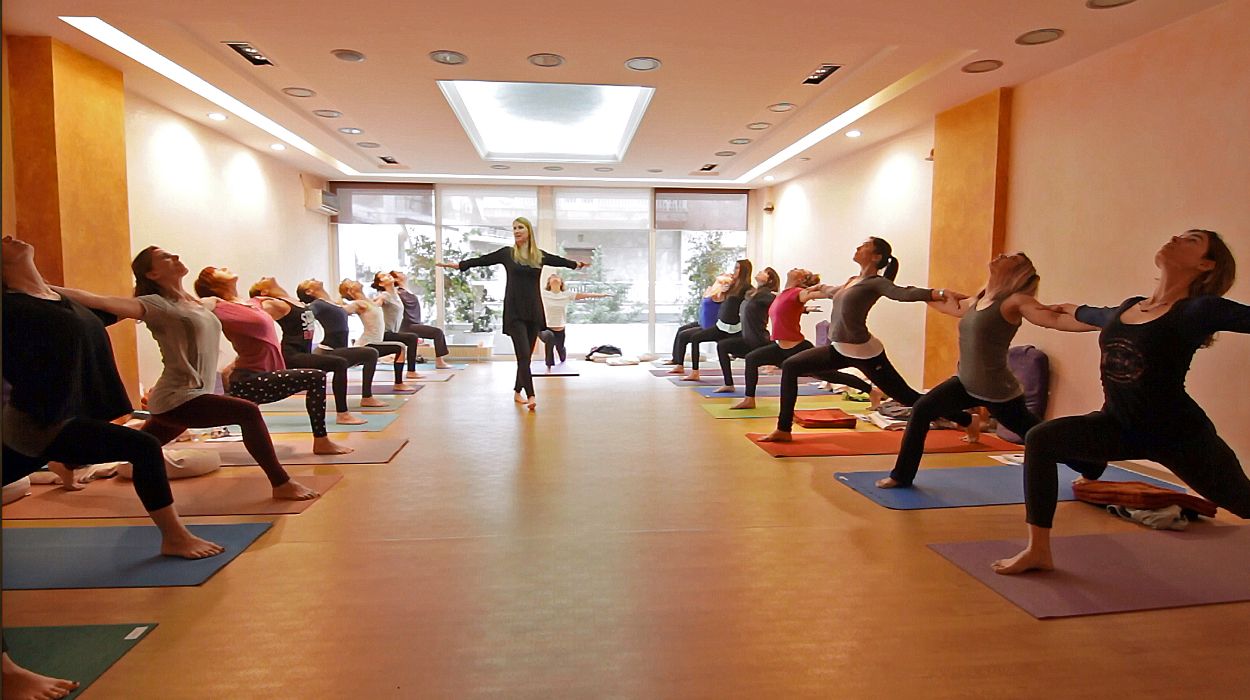
Maja is the founder of the Sensit Yoga™ Somatics system, with 20 years of teaching experience. In January 2026, she has achieved the status of Systemic Family Psychotherapist in Training under Supervision, in Vienna, Austria.
A continuous student of Somatic movement modalities, she draws inspiration from Body-Mind Centering, Feldenkrais and Continuum.
Her university studies include:
- Bachelor degree in Psychotherapy Science at Sigmund Freud University in Vienna, Austria
- Bachelor degree in Economics at the Greek National University of Athens,
- Bachelor (Honours) degree in Social Sciences at the Open University of UK
- Master degree in Political Science at the Greek National University of Athens, on conflict transformation in the Balkans by non-violent means and grass-root peacebuilding
Yoga Alliance International Registered Yoga teacher RYT500
Anusara Yoga™ Inspired Yoga Teacher

Maja's note: Increasingly integrating the seemingly scattered parts of the self through yoga and other awareness practices, we begin to see the profound connections and interdependence everywhere we look. From the separation dream, we gradually wake up to the fact that our personal growth is both contributing to, and strongly dependent on the degree of the evolution of the collective. Whether through meditation, mindful asana practice, aware parenting, acts of self-nurture, being in service to the underprivileged, or through simple random acts of kindness, yoga truly comes alive when the context behind our actions is a desire to contribute to the elevation of consciousness of humanity as a whole.
Yoga Studies:
Maja was drawn to psychology, meditation and spirituality since early childhood. As a teenager she started practicing yoga and periodically attending meditation seminars. With her first yoga teachers - Swami Nirvikalpa and Swami Bhajanananda of Satyananda Yoga tradition - Hatha and Raja yoga - she realised that yoga was a powerful tool for deepening the understanding of the self. For 20 years she studied and trained in yoga and meditation of various styles and traditions. She teaches since 2007. In the last 10 years she has been fully immersed in the field of somatics, studying and infusing her teaching with inspirations from Body Mind Centering, Feldenkreis ATM, Continuum, and other movement modalities.
Research & Publications
Maja's academic work on body-mind integration, somatic practice, and mental health
Body-Mind Integration in Psychotherapy: Theoretical Approaches and a Qualitative Case-Study
This thesis investigates psychotherapy through the lens of mind-body integration, tracing the historical development of psychotherapeutic approaches toward the growing inclusion of body-oriented modalities. To ground theory in lived experience, Maja conducted a qualitative study with four long-term yoga-somatic practitioners, examining how sustained practices of body-mind awareness contribute to their mental health and wellbeing. The interviews demonstrated that yoga-somatics can enhance physical and emotional awareness, support resilience, and serve as a stabilising resource during critical life events. Together, the literature review and qualitative findings argue that incorporating body awareness, movement, and touch into psychotherapy may enrich therapeutic practice and lead to more holistic outcomes.
DOI: 10.13140/RG.2.2.20686.73284 Read on Academia.edu Read on ResearchGate
Bringing therapy to life: Exploring the benefits of yoga and somatic mindfulness in psychotherapy
This paper reviews the substantial body of empirical evidence on the beneficial impact of yoga on mental health, with particular attention to stress reduction, anxiety and depression, emotional regulation, and pain management. It examines the growing trend of incorporating mind-body practices into psychotherapeutic work as a way of complementing and expanding traditional talk-based approaches, aspiring towards a more comprehensive, holistic way of healing. Maja explores both the clinical advantages and the potential challenges of such integration, including questions of practitioner training, therapeutic boundaries, and the careful adaptation of somatic practices for clients with trauma histories. The paper offers a foundation for understanding how somatic mindfulness can enrich contemporary psychotherapy.
The development of social mental health care and community services: Greece as a case study
This paper traces the remarkable progress achieved in European mental health care over the past century, particularly the evolution of medical services, diagnostics, social policies, and social attitudes. Central to the analysis is the process of deinstitutionalisation, which has progressed alongside the growing acknowledgement of the social and relational dimensions of mental illness. Maja examines the shift away from viewing mental issues as residing solely in the individual and their biology, toward a recognition of environment, social status, and economic conditions as meaningful therapeutic factors. Greece serves as a specific case study, illustrating both the achievements and the ongoing challenges of this reform process.